The earth to humanity, so entangled in our own nets.
Go placidly amid the noise and haste – easy for you to say
I hate protests. Introvert me hates crowds. HSP me hates the noise and other sensory overload. And angry shouting spikes my trauma survivor anxiety. Intentionally draw attention to myself in the midst of that?! Are you insane??!! Do you not realize there are walls of bodies hundreds deep and traffic jams blocking your escape???!!! (Oh yeah, I definitely realize that).
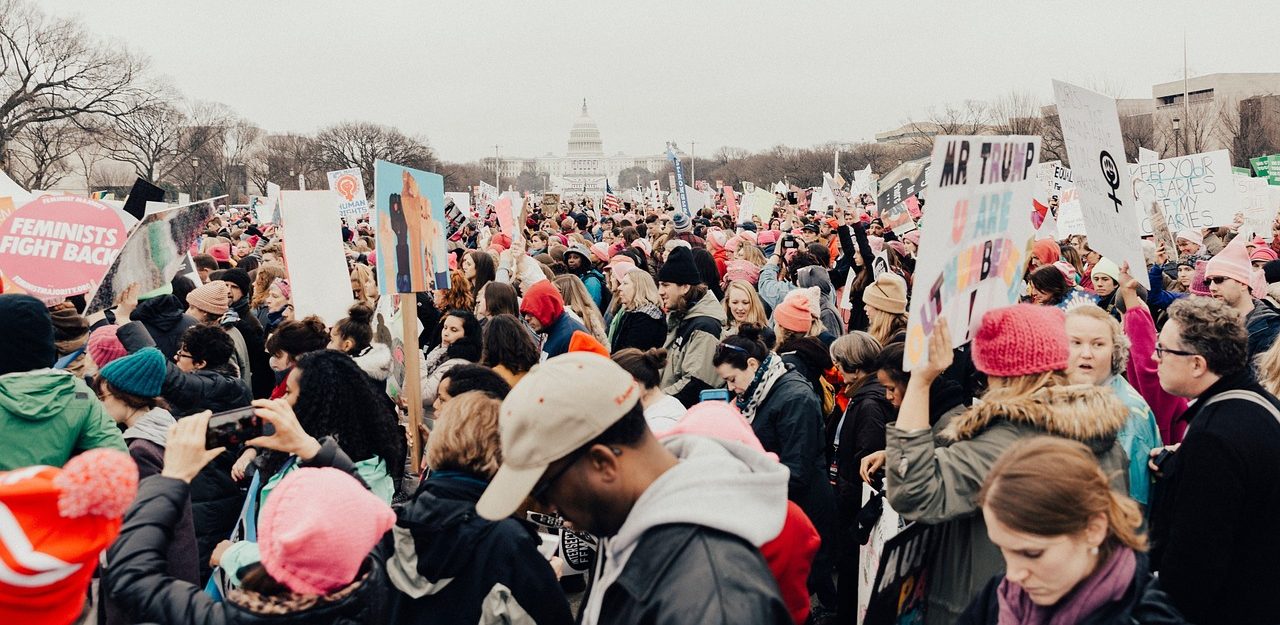
Aaakk!!
Last but not least, risk factors require me to avoid contracting COVID at all costs… and my last booster was 6 months ago.
But when in the course of human events any form of government becomes destructive, it’s time to stand up and be counted, even when every cell in my body is screaming “Get me OUT of here, RIGHT NOW!” Trump’s onslaught of chaos hasn’t directly impacted me yet, but it can’t be long before it does. And it’s already hurt so many people, so badly. I can’t stand by and do nothing. I doubt anyone reading a blog called Sensitive Type can.
Vexatious to the Spirit
I’ve been pondering the psychology of Trump and Musk supporters for years. Or rather, psychologies, as there are doubtless different stokes for different folks. In theory, I sort of understand some of them, though in my unboundaried HSP heart, I’m not sure I can ever fully comprehend someone who has repressed awareness of the distress of others. For better or worse, that’s just not a capacity I have.
Trump/Musk devotees, for all their talk of individualism, prefer to travel in herds. Maybe they need the incessant reinforcement and repetition to drown out their inherent perception of reality. So protesters don’t just create crowds for themselves. Those whose lives have already been kicked in the teeth by Trump’s policies need to see they are not forgotten and alone, and those who are beginning to see the light need models for stepping outside of their previous comfort zone.

Speak Your Truth
This Saturday, April 5th, there will be protests happening all over the U.S., including my small city. I don’t even have to get on a bus, and I have access to a quiet space only a block away if it gets to be too much. Protesting is never easy for me, but I don’t think it can get much less hard than this.
If I can do it, perhaps you can too? Look up your local march location and time, meditate or take kava (or both), scope out a nearby quiet zone in case you need a break, unleash your creative skills on a sign, draft your two friends, put on a privacy-protecting N95 (probably a good idea anyway with all that spittle flying), square your shoulders, gather your resolve, and do what needs to be done.
If you really can’t (I believe you), some locations have scheduled virtual protests for people with disabilities (and thumbs up to whoever finally noticed that protests aren’t for everyone). Just search the Hands Off! site for “virtual.” Since they’re remote, it probably doesn’t matter where you are (but mind the time zones).
Nurture Strength of Spirit
And if you need to vent afterwards, feel free to come back and comment here. I know the private heroism an act like this requires for people like us, even if no one else understands what the big deal is. But unless you’ve been living under a rock or on another planet for the past 2 months, I don’t need to tell you how important it is.
See you there.
Wisdom – I Don’t Get It
Just because we can conceive of a thing doesn’t mean it exists. Take objectivity, for example. We know subjectivity exists, because if you ask five people the same question, they will show it to you. And the omnipresence of subjectivity begets speculation about what the absence of subjectivity might be like. So we give that a name and try to enshrine it in our policies of fact and justice, as if it makes perfect sense for an absence to prove a presence.
But how does it? Who could be unbiased? Where is the place, external to all interests, that an unbiased person could stand?
And then there’s peace. The idea of peace, that is. There’s a transitory internal experience with that name, which begets speculation about a world where everybody could feel that all the time. So we extrapolate from the subjective to the objective, and put the redefined word on posters and jewelry and demonstration signs, and in sermons and meditations and prayers and pleas, and ignore most of human history, as if saying it enough times must call it forth.

But humans are a quarrelsome lot, or at least enough humans are that the rest of us can’t steer clear of their fallout, which makes peace about as concrete as objectivity.
Do they really do us any good, these aspirational ideas, or do they only cause us pain? The activist manual insists they keep us striving for improvement, like that’s beneficial. But maybe improvement is yet another of those dubious abstractions. Is there any evidence humans as a species are growing mentally and emotionally? Or have we conflated biological evolution with technological invention, and arbitrarily – or wishfully – designated the latter as evidence of the former? Our inventions include the means to destroy the planet, and every life upon it, but not the means to preserve and nurture all that.
The thing about evolution is, it works on a grand scale, encompassing multitudes of lives and eons of time. Evolution paints in broad strokes, and doesn’t trouble itself with petty details, like the faces of individuals whose lives wink in and out in the blink of a cosmic eye. A subset of pursuers of peace, objectivity, improvement and wisdom just large enough to keep the quarrelsome majority from self-annihilation is “mission accomplished” for evolution. Evolution doesn’t care whether such a role is eternally, excruciatingly cruel to that minority contingent. Enlightenment is irrelevant to evolution. Only perpetuation scores.
And if the tendency of humans to kill each other by the thousands seems wasteful, that’s a prejudiced view that overestimates our significance to the ecosystem. There’s a hungry food chain full of microbes and insects and other scavengers to be fed, and one species of corpse is as good as another. It’s only in our own estimation that our minds are more important than our meat. Ecologically speaking, we’re probably more useful – and definitely less harmful – as dinner.
So if we aren’t actually evolving, or even capable of it, what does constant striving get us, besides tired?
There are moments of piercing beauty in the world but you can’t catch and hold them to shield you from moments of piercing horror.
This is where I start to feel the need of wisdom. Do I dare to infer there is such a thing from the glaring lack of it everywhere I look? Hardly sounds logical, does it? Ergo, I dare not. I merely wish, wistfully.
Religions lure us with authenticated keys to wisdom, or so they say, but if you want to try, you have to buy. The cost in time and submission is dear, and if you are unsatisfied with your purchase, they’ll say you haven’t paid enough yet.
Their positions on striving vary. Some favor it, so long as you strive per their instructions, no questions asked. Others oppose striving, but strive not to strive. This doesn’t inspire confidence in their guidance to an understanding that answers all questions and heals all wounds.
Is it cynical to question whether the good fight is a purpose sufficient unto to itself, regardless of unproved assumptions, or results? Or is it wisdom to come to peace with an objective assessment that improvement is a fantasy? But wisdom, peace, objectivity and improvement are all fantasies themselves, so how can I? I can only continue to grieve for what I can hold in my heart, but never, ever touch.
Nothing | Doing
It’s been awhile since I posted an update, so here one is. After several years of reading, participating in online support groups and re-evaluating my personal history, it seems highly probable that I have ADHD. I have adjusted my expectations and strategies accordingly.
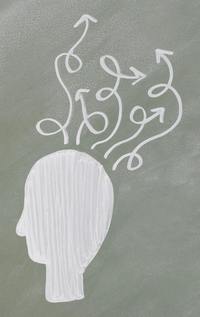 That is, I set procrastination to offset impulsivity, sneak up on tasks without letting myself know so as not to awaken overwhelm, and various other tips and tricks, workarounds and reframes, that are helpful. Somewhat. Not as helpful as family support, well-informed friends and/or expert healthcare would probably be, but one works with what one has.
Between Seasonal Affective Disorder (which is not, despite the name, limited to a specific season) and ADHD, it’s still a daily struggle to get things done. This impacts just about everything in my life – income, relationships, health, home.
Plus, all this new self-conception is taking place against a backdrop of highly unsettled times. Denial, and the deepened retrenchment into dysfunctional behaviors that it brings, are everywhere I look. While I uncover answers to “why am I like this?,” answers to the larger question, “why are humans like that?,” are harder to come by.
With zero safety net, and a high risk of developing a hereditary condition I have thus far avoided should I contract even a “mild” case of COVID, I’m still masking and avoiding shared indoor environments. Happily, I live where this is accepted without comment or harassment. But it further limits my already limited life.
The thing is, I don’t necessarily experience these limitations as a restriction. In many ways, I live as most people lived only a century or two ago, rarely leaving a well-known local environment.
Many people still do live that way, and there’s something to be said for it. I haven’t owned a car in decades, as I wait – and wait, and wait – for an EV I can afford. So I was accustomed to a limited range of travel long before getting on a bus became a serious risk to my health. I wish my small range was rural rather than suburban, and there weren’t SO. MANY. NEIGHBORS. SO. CLOSE. But accepting that, as I must, there are still a lot of flowers and beautiful clouds and a surprising amount of wildlife where I live.
When I had a car, it felt like a shell. I passed through environments without touching them, or being touched by them. Some days I miss that of course, when the weather is rude or my heart is bruised. But lacking the shell imposes a sort of involuntary mindfulness. I wish for filters when the yard services descend, with their ear-racking, fumacious motors. But then again, when my neighbors pop out of their morning doors into their morning cars, intent upon not spilling their morning coffee and keeping to their morning schedule, never noticing the wild turkey on the lawn next door or the rare luminescence in the sky above, I’m thankful for my wide open brain.
So, my journey continues, as journeys do, and just when I think I know where I’m going, I find myself somewhere else. But home, age has taught me, is inside of you. So that’s OK.
Why Do You Ask?
Do you have a bottled-up (or not) rant about ritual questions asked by people who don’t want to know, and the social tyranny which obliges phony answers even when they are the opposite of the truth? Then here’s a treat for you by the prolific, inimitable, illusionary (about which more later) British poet, Brian Bilston.
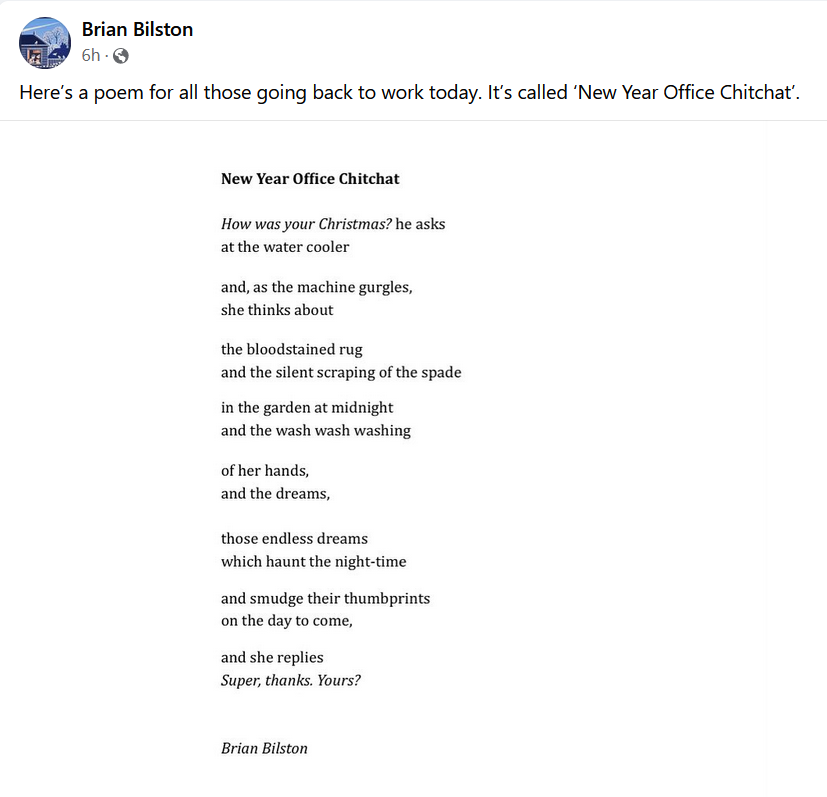
As posted by the author on Facebook, January 2, 2024. All rights his.
Brian Bilston is a rising star on the UK poetry scene, with his self-deprecatory, ironic, infinitely various, and frequently hilarious poems. I suspect Continue reading
Happy World Introvert Day
Subjectivity: A review of The Vegetarian by Han Kang
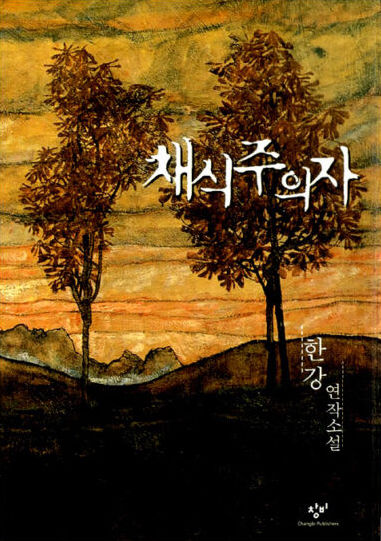 I wrote this review in 2016, intending to publish it in a different venue, then forgot about it. I’ve added references to two films that came out after I wrote it.
As I discuss, it’s debatable whether The Vegetarian really qualifies as a feminist novel. It’s about people who have retreated so entirely into their wishful fantasy lives that they are incapable of accurately perceiving the world around them – or themselves. In our third year of COVID, this is more apropos than ever. Continue reading
Fear It Self
In a previous post (Isms), I mentioned in passing that I’ve evolved my own beliefs about the meaning/purpose of life in the meta sense, but did not elaborate upon what they were.
Om I/God
Here’s what I think is going on, to the best of my scrawny human brain’s capacity to understand such things. Continue reading
The Nature of Words
Since I didn’t discover I was an HSP until I was over 50, I’ve got a lot of personal backstory that I’ve never revisited through the lens of personality type. Sometimes things drop suddenly from the overflowing attic of my past to unveil themselves in a new light.
The Words of Nature
Certain writers evoke transcendent experiences of the natural world. In my 20s, when I was introduced to Mary Oliver’s poetry, I began to think of them as nature ecstatics. Strangely, this is not necessarily what others noticed about their writing, but as for me, I could relate.
Mary Oliver wasn’t my first nature ecstatic – the first was probably Sara Teasdale. An author gave me a book of her poems for children when I was in elementary school. Soon after, I encountered Lucy Maude Montgomery (best known for her prose, but definitely a nature ecstatic). I found Yeats’ Lake Isle of Innisfree when I was in high school. Somehow, I made it all the way to my 30s before I heard of Rumi.
Much later, I came to understand I was an HSP. It didn’t take long to notice that all of my favorite, nature ecstatic poets were decidedly HSP-ish too. Or, as L.M. Montgomery would call them, kindred spirits. Continue reading
ADHD Pleads Guilty
 As I continue to learn about ADHD, previously unsuspected associations between ADHD and lifelong quirks and struggles arise every day. Sometimes depression and/or personality are also factors, but identifying ADHD as an additional suspect finally illuminates why it has been so effing hard to get a handle on some of these things, no matter how long or how hard I tried. I’m simply outnumbered!
Here are a few of them: Continue reading

